
If you’re a real estate investor, chances are you’ll eventually sell a property. Normally, that sale would trigger capital gains taxes, which can significantly reduce your profits. Fortunately, it doesn’t have to be that way. By utilizing a 1031 exchange, you can defer paying capital gains and depreciation recapture taxes by reinvesting your proceeds into another qualifying property.
In this article we go over the basics of a 1031 exchange and answer the following questions:
- What is a 1031 exchange?
- How does a 1031 exchange work?
- What qualifies for a 1031 exchange?
What is a 1031 Exchange?
A 1031 exchange is arguably the most valuable tax advantage available to real property owners. Stemming from section 1031 of the Internal Revenue Code, a 1031 exchange allows a property owner to defer paying capital gains and depreciation recapture tax on the sale of their property by investing the proceeds into a “like-kind” property.
The US Internal Revenue Code Section 1031(a) reads as follows:
In General – No gain or loss shall be recognized on the exchange of property held for productive use in a trade or business or for investment if such property is exchanged solely for property of like kind which is to be held either for productive use in a trade or business or for investment.
Exception – the following assets are not eligible for 1031 exchange:
- Property held primarily for resale (inventory or flips)
- Stock, bonds, or notes
- Other securities or debt instruments
- Partnership Interest
- Certificates of trust or beneficial interests
For example, an investor purchased a property five years ago for $100,000 and sells it today for $300,000 net of closing costs. Because there is a capital gain of $200,000 from the sale of the property, that amount will be subject to capital gains tax. However, if the investor uses a 1031 exchange to purchase another property, they can defer paying the capital gains tax. This would allow the exchanger to utilize the buying power of the full $300,000 (less any transaction fees not accounted for in this simplified example), which is why a 1031 exchange is such a powerful tool.
How Does a 1031 Exchange Work?
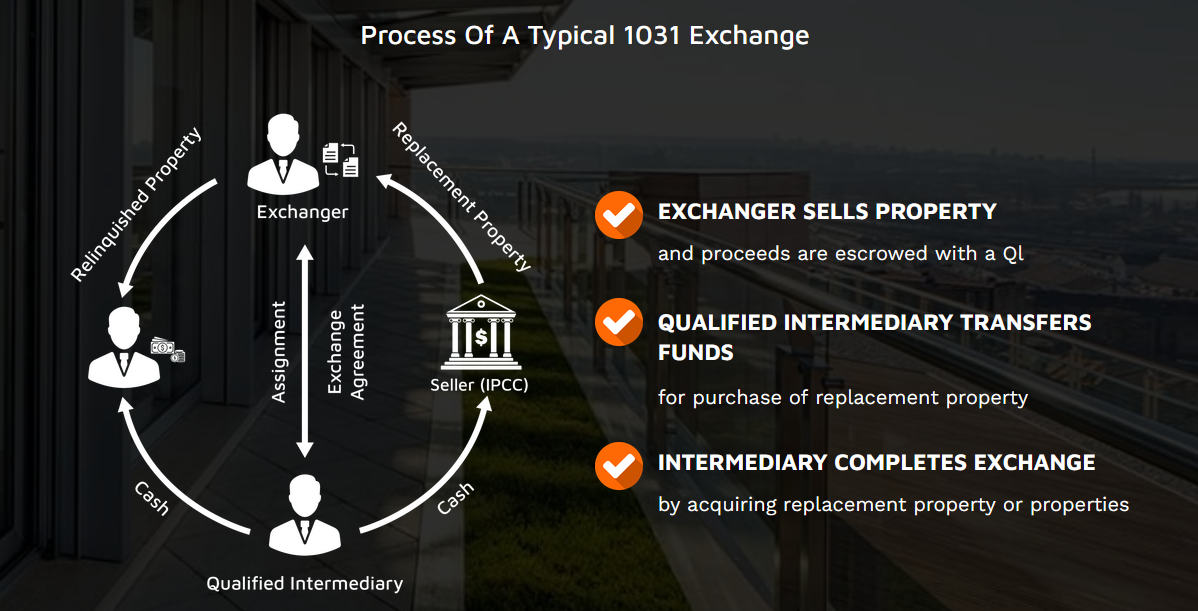
As noted above, a 1031 exchange can be a valuable tax-deferral and wealth-building strategy. However, the process involves specific IRS rules and timelines that must be followed carefully to maintain compliance. Here’s a simplified overview of how a standard 1031 exchange works:
1. Engage a Qualified Intermediary (QI)
The first step is to contact a Qualified Intermediary (QI)—the independent third party responsible for holding the sale proceeds in escrow until the exchange is complete. The QI plays a critical role in maintaining the integrity of the exchange, ensuring that you never take constructive receipt of the funds. Because your QI will hold a substantial sum for an extended period, choose a reputable and experienced professional.
2. List and Sell the Relinquished Property
Once your QI is in place, you can list and sell your property, ideally with a trusted real estate broker. Throughout the sale process, maintain close communication with your QI to ensure the transaction structure remains compliant with 1031 exchange requirements.
3. Identify and Acquire Replacement Property
After the sale closes, you’ll have:
- 45 days to identify potential replacement properties, and
- 180 days (from the date of sale) to close on one or more of the identified properties.
When you’re ready to close, your QI will transfer the exchange funds directly to the closing agent—ensuring you remain compliant by never taking direct control of the proceeds.
At that point, your 1031 exchange is successfully completed, and your capital gains and depreciation recapture taxes are deferred.
Note: The 1031 process involves many nuances, so it’s important to consult with an experienced Qualified Intermediary and tax advisor before initiating an exchange.
What Qualifies for a 1031 Exchange?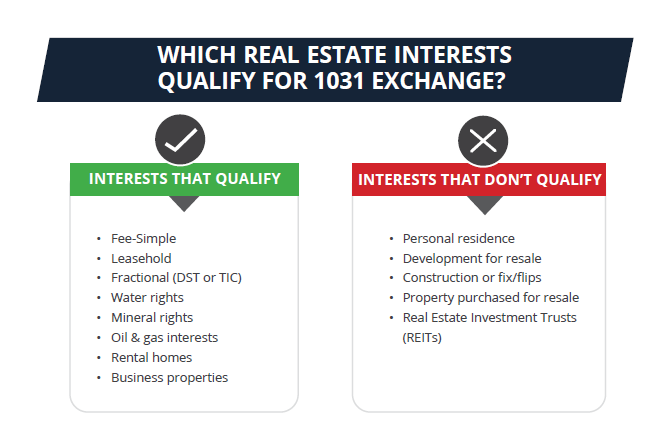
In addition to the strict timelines, both the property you sell (the relinquished property) and the one you buy (the replacement property) must be considered “like-kind.”
Many investors assume “like-kind” means exchanging the same type of property—such as selling an office building and buying another office building—but that’s not the case. The term simply means that both properties must be real property held for investment or business use.
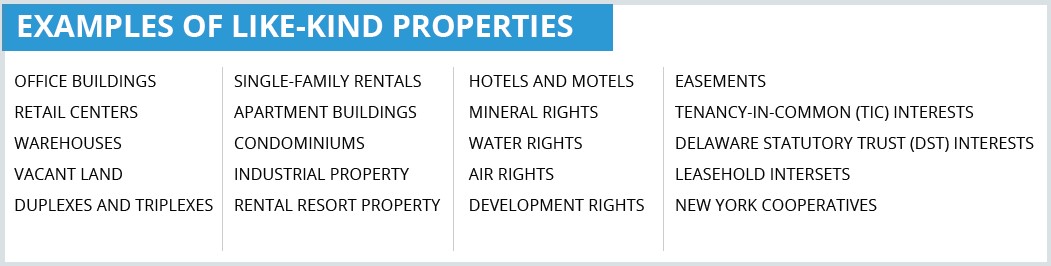
Examples of qualifying like-kind properties include:
- Office buildings
- Retail centers
- Warehouses
- Multifamily and single-family rentals
- Vacant land
Even less common real estate interests such as mineral, water, or air rights—as well as easements and development rights—can qualify under the like-kind standard.
Conclusion
We hope this article helped shed some light on the basics of 1031 exchanges and how to utilize on as a part of your real estate investment wealth building strategy. Although the process can be complicated and there are strict timelines to follow, having the opportunity to defer capital gains taxes is well worth the effort.
If you are considering a 1031 exchange for your property or have additional questions about the process, don’t go it alone. Our experts at 1031 Qualified Intermediary have helped countless investors navigate the 1031 exchange process and we would love to assist you as well.https://1031qualifiedintermediary.net/#form
📅 Ready to get started? To see whether a 1031 exchange is right for you, call (888) 245-1031, email info@1031qualifiedintermediary.net or schedule a consultation with one of our experts today.

Download your free copy of “The Power of 1031 Exchanges” to learn more about how 1031 exchanges can complement your portfolio.