In the context of a 1031 exchange, “like-kind” simply means that you are exchanging one form of real property for another. This does not mean the properties must be identical in use or type.
For example, you can sell an apartment complex and purchase a warehouse, or sell a retail center and buy an office building—both would qualify.
The key requirement is that both properties are held for investment or business purposes. As long as the real estate is used to produce income or for a business function, it likely satisfies the like-kind standard.
In this article, we dig into what defines the “like-kind” requirement and examine:
- What does “like-kind” mean?
- Properties that qualify for a 1031 exchange
- Properties that do not qualify for a 1031 exchange
What Does “Like-Kind” Mean?
The “like-kind” requirement in a 1031 exchange simply means that the investor must exchange one form of real property for another. This could include transactions like selling an apartment complex to purchase a warehouse or selling a retail center to purchase an office building.
Many people believe this requirement means you are limited to exactly the same type of property, such as selling an office building to buy another office building, but that is not the case. As long as the properties in the transaction are used for an investment purpose or for the purpose of a business, there’s a good chance they will qualify under the “like-kind” requirement.
Properties that Qualify for a 1031 Exchange
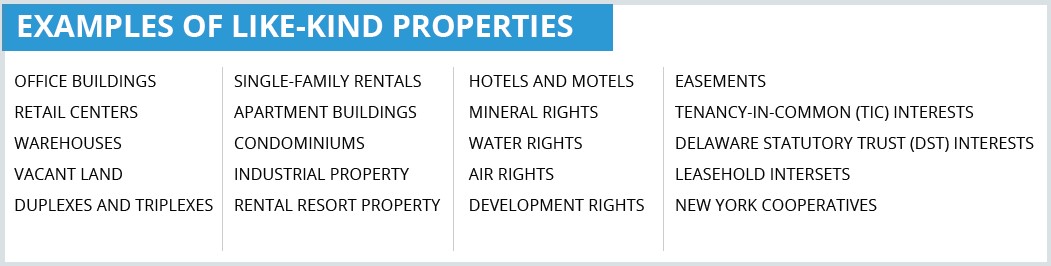
If you are a real estate investor, you will be happy to know that the list of qualifying properties is extensive and includes most common property types used for investment purposes.
Commercial Properties
Nearly all types of commercial real estate qualify under the 1031 “like-kind” definition, provided the property is held for investment or business purposes.
Common examples include:
- Government-leased buildings
- Office buildings
- Retail centers
- Industrial facilities
- Hotels and resorts
- Self-storage facilities
- Medical buildings
- Marinas and golf courses
- Special-purpose or religious-use properties
Residential Properties
As with commercial properties, nearly every form of residential property qualifies for a 1031 exchange. The major exception to this is your personal home, which does not qualify.
The most common properties in this category are:
- Single family rentals
- Duplexes and triplexes
- Apartment complexes
- Condos
- Manufactured Housing
- Assisted Living Facilities
Unimproved (Raw) Land
While improved properties are great, another asset that qualifies for 1031 exchange is unimproved properties. Unimproved property simply means no major development has taken place on the land. Under the “like-kind” provision, you could sell improved property to buy unimproved property, or vice versa.
The most common properties in this category are:
- Raw land
- Vacant lots
- Agricultural
- Farms and ranches
Rights, Easements and Interests
Certain nontraditional forms of real estate ownership may also qualify under 1031 exchange rules. These represent interests in real property that can be bought, sold, or exchanged
The most common properties in this category are:
- Delaware Statutory Trust (DST)
- Tenancy in Common (TIC)
- Land easements
- Leasehold (30-year or more)
- Mineral rights
- Oil & Gas rights
- Air rights
- Water rights
- Development rights
- New York cooperatives
Although not technically physical property in most cases, these rights have been deemed acceptable for a like-kind exchange because they represent an interest in real property and could be sold at a gain.
Easements are another form of right that gives permission to cross someone else’s land for a specific purpose. Many easements involve the right to ingress and egress, while others involve utility or pipeline easements.
Interests also include tenancy-in-common, leasehold and Delaware Statutory Trust interest. These interests can be traded for other forms of real property in a 1031 exchange, with certain caveats that go beyond the scope of this article.
While all these forms of ownership do qualify for 1031 exchange, they often follow stricter guidelines than the more common forms of ownership. We highly recommend doing your own research and consulting with an expert if you are considering a 1031 exchange for your right, easement or interest.
Properties that Do Not Qualify for a 1031 Exchange
Although the list of qualifying properties is long and includes the most common types of real property that you are likely to run into, there are a few forms of ownership that do not qualify under the “like-kind” requirement.
Examples of property that do not meet the “like-kind” requirement include:
- Real Estate Investment Trusts (REIT)
- Primary residence
- Residential fix and flip projects
- Ground-up developments held for resale
- Stocks, bonds and other securities
- Partnership interests
- Foreign property exchanged for U.S. property
The list of “like-kind” property is constantly being reevaluated by law makers. Exchangers should always engage with a licensed CPA and Qualified Intermediary for the latest “like-kind” qualifications.
Conclusion
We hope this article has given you a good overview of which types of properties qualify for 1031 like-king exchange. Although a 1031 exchange can be complicated, they are a powerful tool that every real estate investor should have in their toolkit.
The “like-kind” requirement under Section 1031 is far more flexible than many investors realize. As long as the real estate involved is held for investment or business purposes, it’s likely to qualify. With proper planning, a 1031 exchange can be an invaluable tool for building wealth, deferring taxes, and optimizing your investment portfolio.
If you are considering a 1031 exchange for your property or have additional questions about the process, don’t go it alone. Our experts at 1031 Qualified Intermediary have helped countless investors navigate the 1031 exchange process and we would love to assist you as well.
📅 Ready to get started? To see whether a 1031 exchange is right for you, call (888) 245-1031, email info@1031qualifiedintermediary.net or schedule a consultation with one of our experts today.

Download your free copy of “The Power of 1031 Exchanges” to learn more about how 1031 exchanges can complement your portfolio.
Impact of fees/expenses – Costs associated with the transaction may impact investors’ returns and may outweigh the tax benefits.