So, you’ve decided to move forward with a 1031 exchange to defer capital gains and depreciation recapture taxes—smart move!
While the tax benefits are significant, the process can be complex and often leaves property owners feeling uncertain about where to begin. There are several key steps to consider before selling your property—steps that seasoned investors and Qualified Intermediaries (QIs) know well.
In this article, we’ll break down the five essential steps to take before entering a 1031 exchange—and how to set yourself up for a successful outcome.
The 5 steps to consider before entering a 1031 exchange are:
- Include QI Before the Close
- Include Exchange Language in Sales Contract
- Know the Rules of an Exchange
- Identify Replacement Properties Early
- Use a Delaware Statutory Trust (DST) as a Backup
Step 1: Include QI Before the Close
If you’re planning a 1031 exchange, the first and most critical step is to involve a Qualified Intermediary (QI)—also called a 1031 accommodator—before your property closes.
The QI acts as an independent third party who facilitates the exchange and ensures it complies with IRS Section 1031. Think of your QI as the bridge between you, the buyer, and the IRS, making sure all funds and documents move according to federal regulations.
The QI’s primary role is to prevent the investor from taking possession of the sale proceeds, which would disqualify the exchange. Instead, the QI holds the funds in a qualified escrow account and oversees the transaction under the IRS “safe harbor” rules (Reg. 1.1031(k)-1(g)(4)).
In short: no QI, no valid 1031 exchange.
Step 2: Include Exchange Language in the Sales Contract
Including 1031 exchange language in your sales contract is another crucial step that many first-time exchangers overlook.
This language establishes your intent to perform a 1031 exchange and notifies all parties that the contract will be assigned to your Qualified Intermediary. The IRS requires this written intent to ensure compliance with Section 1031.
You can include this language directly in your purchase and sale agreements or add it later via an addendum.
⚠️ Important:
If you omit exchange language—or take possession of the funds at closing—your exchange will be disqualified.
Step 3: Know the Rules of an Exchange
A successful 1031 exchange hinges on adhering to several strict IRS rules. Understanding these before you start can help you avoid costly mistakes.
45-Day Identification & 180-Day Closing Timelines
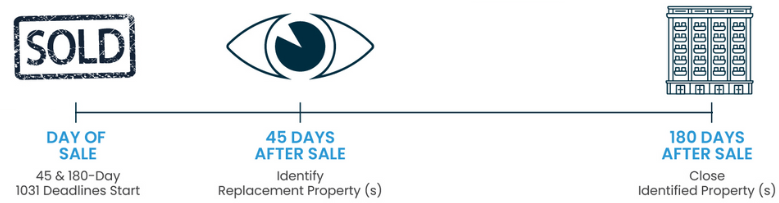
Replacement properties under consideration for acquisition in a 1031 exchange should be identified to the QI and must be identified no later than midnight of the 45th calendar day following the close of the relinquished property sale transaction.
Once identified, the exchanger has an additional 135 calendar days (180 days from sale of relinquished property date) to officially close on the identified replacement property(s) in order to successfully satisfy the exchange. Weekends and holidays are not excluded from 1031 exchange timeline rules. Be sure to work closely with your chosen QI in order to stay on top of important deadlines.
Like Kind
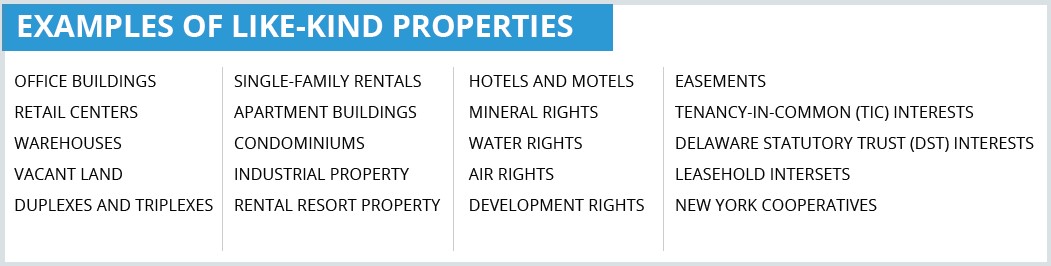
The “like-kind” rule simply means you must exchange one form of real property for another held for investment or business purposes.
You’re not limited to swapping “like for like” (e.g., apartment for apartment). For example, you could sell an office building and purchase a retail center, industrial property, or even raw land.
Qualifying property types include:
- Office, retail, industrial, or medical buildings
- Multifamily and single-family rentals
- Land, farms, and ranches
- Mineral, water, or air rights
- Easements and development rights
Identification Rules

When identifying potential replacement properties, 1031 exchange investors must comply with one of the three property identification rules. These rules include the Three Property Identification Rule, the 200% of Fair Market Value Identification Rule, and the 95% Identification Exception.
- Three-Property Rule: Identification of up to three properties regardless of the total value of property identified.
- 200% Rule: Identification of any number of properties wherein the combined FMV (fair market value) does not exceed 200 percent of the relinquished properties’ FMV.
- 95% Rule: Identification of any number of properties regardless of the aggregate FMV, as long as at least 95 percent of the property is ultimately acquired. This rule is only used when more than three properties are identified with a total aggregate FMV exceeding 200%.
Replacing Equal or Greater Value, Equity and Debt
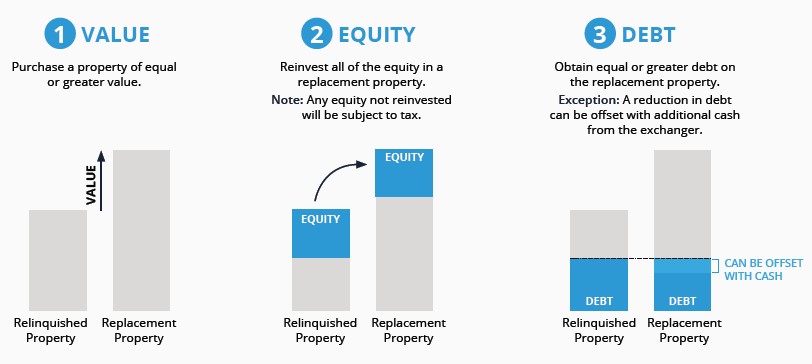
For the 1031 exchange to work as it is designed, in most cases you’ll want to purchase a property of equal or greater value than the one you are selling. This difference in value is what will allow you to grow your portfolio and “trade up,” which is typically what you are trying to accomplish when utilizing a 1031 exchange.
Trading into a property with a equal or greater value is also what allows the rules surrounding your equity to work correctly. To avoid paying any capital gains tax on the transaction, you must reinvest all the equity from the relinquished property into the new property. If there is equity left over that is not reinvested, aka boot, that amount will be taxed.
Step 4: Identify Replacement Properties Early
Time is your biggest challenge in a 1031 exchange. While 45 days may sound like plenty, the identification period passes quickly once you factor in property searches, negotiations, inspections, and financing.
We recommend beginning your search before your sale closes to maximize the full 45 days. Early preparation gives you more time for due diligence and flexibility if your first choice falls through.
Step 5: Use a Delaware Statutory Trust (DST) as a Backup
When deadlines are tight or suitable replacement properties are hard to find, a Delaware Statutory Trust (DST) can be a valuable backup—or even your primary strategy.
DSTs offer pre-vetted, pre-financed, and pre-closed institutional-quality properties that can be acquired quickly. This structure makes them ideal for investors facing 1031 timing challenges or seeking a more passive real estate investment.
DSTs are also managed by professional property management firms, making them attractive to investors who:
- Wish to invest a smaller amount while maintaining 1031 eligibility
- Prefer hands-off, passive ownership
- Want to diversify across property types or markets
- Seek to limit personal liability
- Need to identify and close quickly
Conclusion
We hope this article has given you a good overview of what a 1031 exchange is along with the potential advantages and limitations. When performing a 1031 exchange, the IRS has many stringent rules and regulations regarding the 1031 exchange code. Meeting deadlines can be difficult and can sometimes lead to a failed exchange. Luckily, investors today have many resources to protect their investments. Even when faced with a potential failed exchange, there are many ways to preserve your 1031.
It is strongly recommended to identify more than one replacement property as backup in the event problems arise with the first target acquisition property. By identifying a second or third replacement property, you significantly increase your ability to successfully 1031 exchange.
A Delaware Statutory Trust (DST) may be a powerful alternative. Since DST properties are pre-vetted, pre-financed and pre-closed, a DST can offer exchangers the ability to close quickly and alleviate securing additional financing from lenders.
In addition, DST properties come with professional property managers to handle all aspects of leasing, maintenance, and management efforts for simple, turnkey ownership. By identifying a DST property as 1031 backup, an investor can gain the confidence to successfully close their exchange by eliminating most issues associated with a traditional exchange.
Get the backup you need with our partner Exchange-X, the leading DST investment platform. Gain instant access to dozens of 1031 eligible commercial properties to choose from.
If you are considering a 1031 exchange for your property or have additional questions about the process, don’t go it alone. Our experts at 1031 Qualified Intermediary have helped countless investors navigate the 1031 exchange process and we would love to assist you as well.https://1031qualifiedintermediary.net/#form
📅 Ready to get started? To see whether a 1031 exchange is right for you, call (888) 245-1031, email info@1031qualifiedintermediary.net or schedule a consultation with one of our experts today.

Download your free copy of “The Power of 1031 Exchanges” to learn more about how 1031 exchanges can complement your portfolio.